
Auto Service
Wheel Alignment
One nasty pothole can ruin your whole day. Don't let poor alignment or worn steering and suspension parts affect your car's safety and performance. Our expert technicians can inspect your vehicle's alignment, steering and suspension components and help get you back on the road. When it comes to keeping you and your car safe, we will never steer you wrong.
Our Process
- Test drive vehicle to experience any driveability issues
- Perform full steering and suspension component inspection
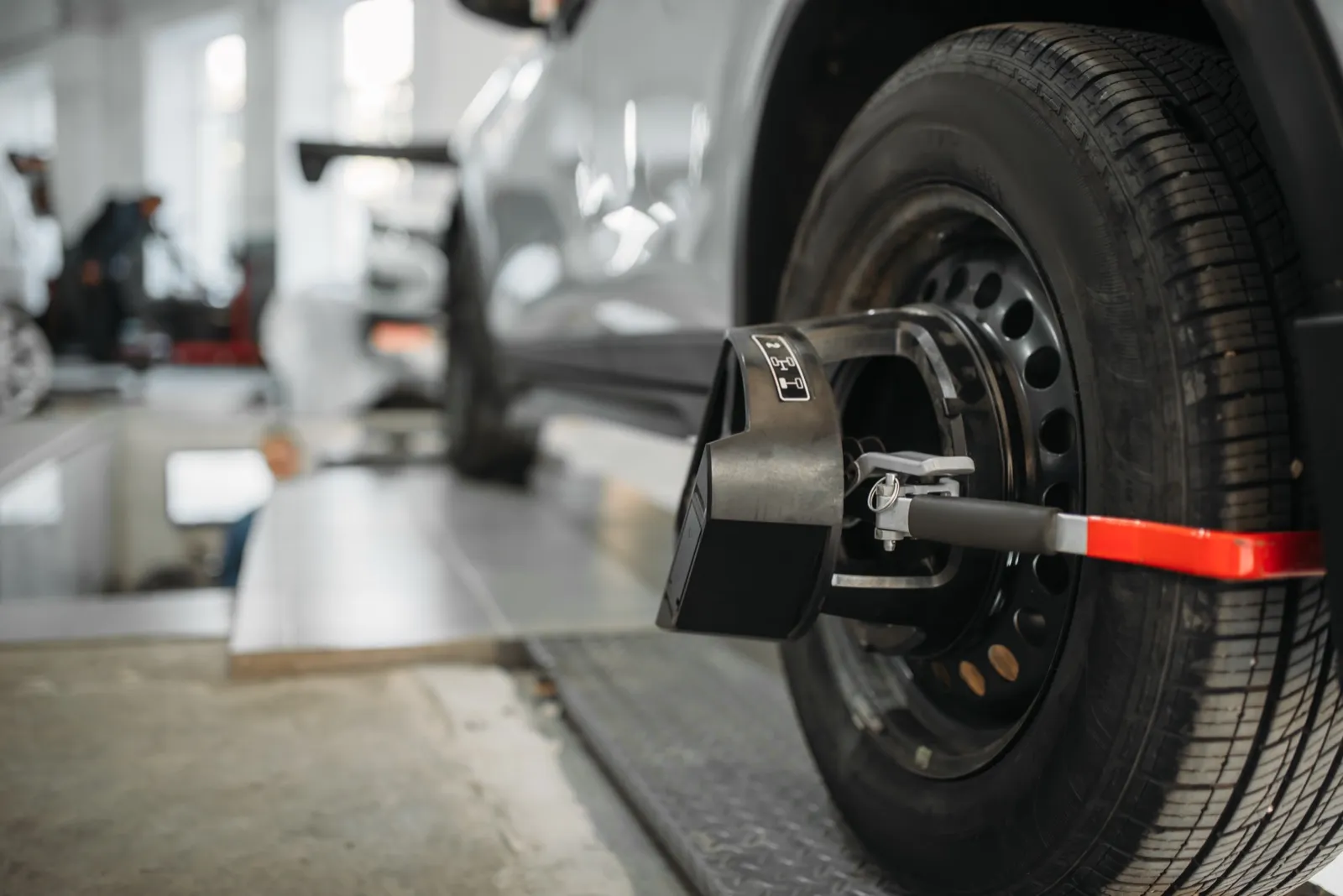
- Connect alignment machine to identify and make any necessary adjustments
- Perform a final test drive to ensure the vehicle drives and tracks correctly
Benefits of maintaining proper alignment:
- Better Fuel Efficiency
- Improved ride
- Longer tire life
- Less wear and tear on steering and suspension components
So, What is Alignment?
Simply put, a wheel alignment consists of adjusting the angles of the wheels so that they are perpendicular to the ground and parallel to each other. The purpose of these adjustments is maximum tire life and a vehicle that tracks straight and true when driving along a straight and level road.
Vehicle alignment adjustments are broken down into 3 areas: caster, camber, and toe.
Caster
Caster angle identifies the forward or backward slope of a line drawn through the upper and lower steering pivot points when viewed directly from the side of the vehicle. Caster is expressed in degrees and is measured by comparing a line running through the steering system's upper and lower pivot points to a line drawn perpendicular to the ground. Caster is said to be positive if the line slopes towards the rear of the vehicle at the top, and negative if the line slopes towards the front.
Camber
Camber angle identifies how far the tire slants away from vertical when viewed directly from the front or back of the vehicle. Camber is expressed in degrees, and is said to be negative when the top of the tire tilts inward toward the center of the vehicle and positive when the top leans away from the center of the vehicle.
Toe
Toe angle identifies the exact direction the tires are pointed compared to the centerline of the vehicle when viewed from directly above. Toe is expressed in either degrees or fractions of an inch, and an axle is said to have positive toe (in) when imaginary lines running through the center lines of the tires intersect in front of the vehicle and have negative toe (out) when they diverge. The toe setting is typically used to help compensate for the suspension bushings compliance to enhance tire wear. Toe can also be used to adjust vehicle handling.
ADAS: Advanced Driver Assist Systems
This acronym, ADAS, may not mean much to you, but most drivers utilize these systems every day. ADAS is the term used to describe the convenience and safety systems being implemented in vehicles. Examples of this include park assist, pre-departure warning, adaptive cruise control, and blind spot detection. Some of these systems are related to the alignment of your vehicle. This helps the computers and sensors built in to your vehicle know its precise location relative to others.
In vehicles equipped with ADAS components, certain parts of the system may need to be calibrated when an alignment is performed or if you have been in an accident. Each vehicle is unique in the requirements and calibration of each system.
Worn shocks, struts, tie rods or ball joints can keep an alignment from holding. If your vehicle pulls or wears tires unevenly, have your steering and suspension inspected at the same time.
Steering & suspension repairServing St. Joseph, Alexandria, and Belgrade, Minnesota, we help keep your vehicle driving straight and true. Schedule an alignment today to protect your tires and improve your driving experience!
Proudly serving the St. Cloud area from our St. Joseph, Alexandria and Belgrade locations.
Frequently asked questions

Pull up to the counter
Ready to roll? Let's talk.
Request an appointment online, or give us a call. We're happy to help.