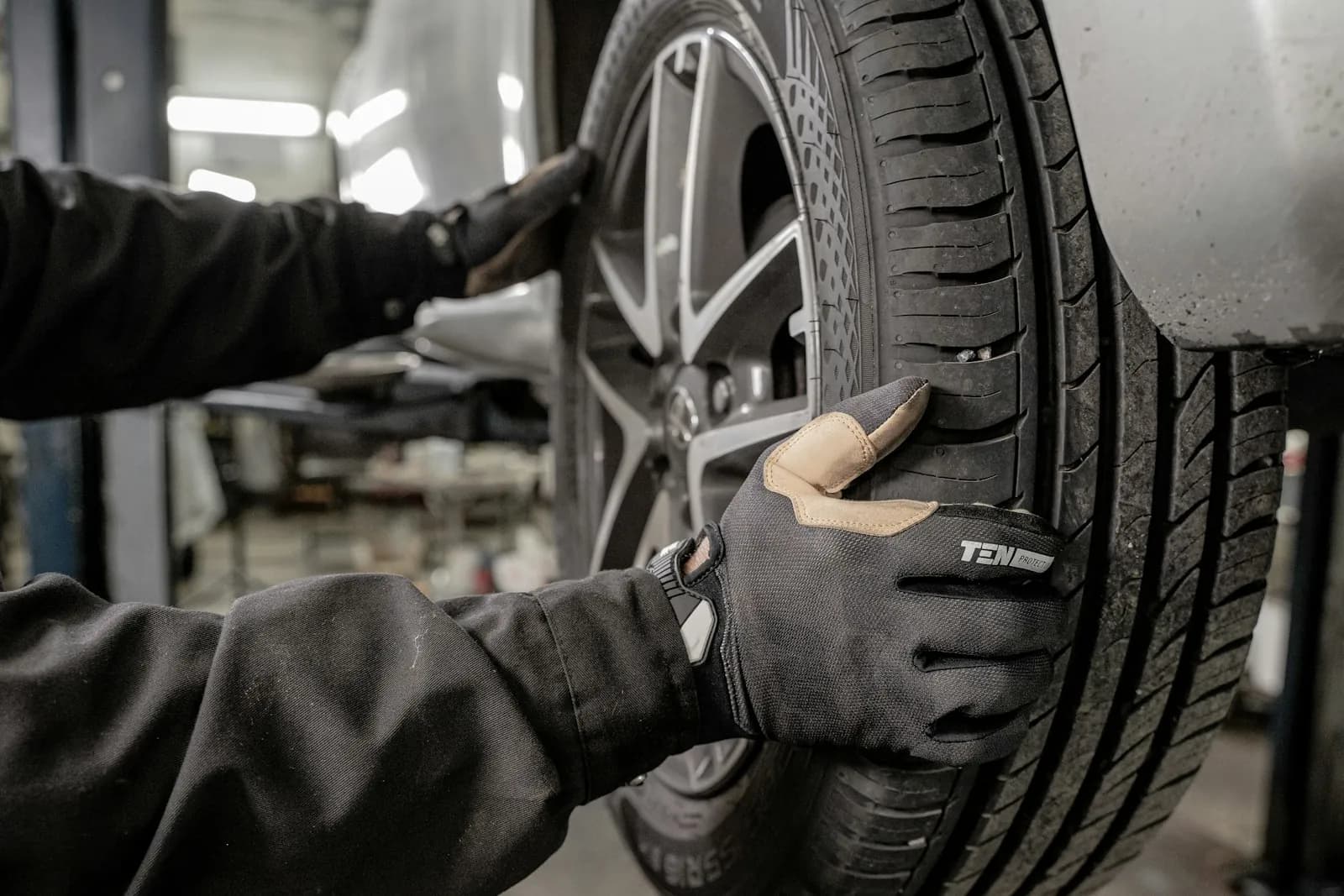
Wheel balancing is the process of correcting small weight differences in a wheel-and-tire assembly so it spins smoothly instead of vibrating. The telltale sign you need it is a steering wheel that shakes at highway speed, usually showing up somewhere around 55 to 60 mph. It's one of the quickest services we do, and skipping it costs you in tire life and ride comfort.
What is wheel balancing?
No tire or wheel is perfectly uniform. Even brand-new ones have spots that are slightly heavier than others, often by less than an ounce. That sounds like nothing, but at 60 mph your tires are spinning roughly 700 to 800 times every minute, and a small heavy spot becomes a rhythmic tug on the whole assembly, over and over, mile after mile.
Balancing corrects for that. We mount each wheel on a computerized balancer that spins it to find the heavy spots, then attach small counterweights to the rim to even them out. The result is a wheel that rotates true at any speed: a smoother, quieter ride, more even tread wear, and less strain on your suspension.
What are the symptoms of unbalanced tires?
The classic symptom is a steering-wheel shake at highway speed. It tends to be steady rather than random, and it may get worse, or mysteriously smooth out, as your speed changes. If the vibration comes through the steering wheel, the imbalance is usually in a front wheel; if you feel it in your seat or the floorboard, look to the rears.
There are quieter clues, too. Cupped or scalloped patches of uneven tread wear, a hum or drone that changes with speed, or a vibration that appears suddenly after you hit a pothole. A hard enough hit can knock a wheel weight clean off the rim. Around here, spring pothole season keeps us busy with exactly that.
One point of confusion worth clearing up: if your car pulls to one side, or the steering wheel sits crooked while you're driving straight, that's an alignment problem, not a balance problem. A balance issue shakes; an alignment issue steers. We break down the difference in our guide to alignment vs. balancing.
How often should you balance your tires?
There's no strict mileage schedule for balancing the way there is for oil changes. It's more of an as-needed service. Every tire we install gets balanced before it goes on the vehicle, so a new set starts life smooth. From there, the honest answer is: rebalance when you feel it.
That said, there are a few natural moments to have it checked. Tire rotation is a common one, since the wheels are already off the vehicle. The spring and fall changeover is another, if you swap between winter and summer sets. And any time a tire is repaired or remounted, it should be rebalanced. Even a small change to the assembly can shift the balance point.
Balance also drifts on its own. Wheel weights can loosen and fall off, tread wears unevenly, and a Minnesota winter of frost heaves and potholes takes its toll. A set that spun perfectly a year ago may not today.
If your steering wheel has developed a shake, or your tires are wearing in odd patterns, don't drive on it for months. The vibration itself is annoying, but the real cost is chewed-up tread and extra wear on suspension parts and wheel bearings. Balancing is part of our tire repair and rotation service, and it doesn't take long. Request a time online or call us at (320) 363-7246 and we'll get you back to a smooth ride.